![[personal profile]](https://www.dreamwidth.org/img/silk/identity/user.png)

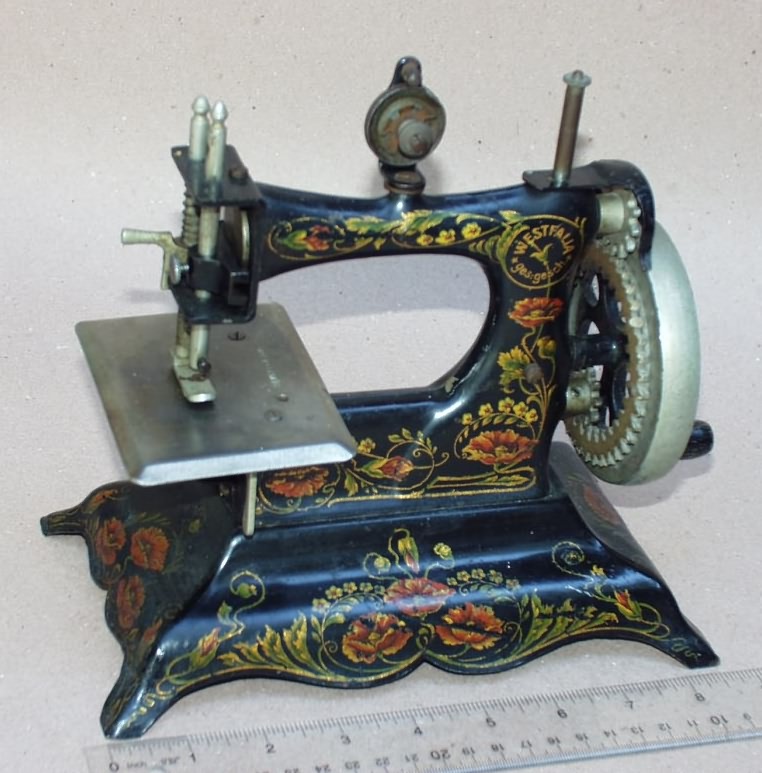
it sewed through 6 layers of jeans, 4 layers of cotton T-shirt (with print on it), and I haven't tested anything heavier yet. it actually seemed like it worked a lot better on thicker fabric but that just might be me not knowing how to mess with the tension. it's really tiny and easy to hold and works well with just one hand (and i'm not a strong guy!!). it's pretty quiet, about as loud as a stapler. if the "bobbin thread" becomes a tangled nest it's EXTREMELY easy to get rid of, WAY easier than on a real machine. the "feeders" that hold the fabric stuck to the pressure foot and move it forward with each stitch work really well. it was also a lot easier to thread than a normal machine for me, probably since you can get your face and hands so much closer to this one.
so far all the problems are just "user error": if the tension is wrong it doesn't sew at all (the stitches don't move forward) or they bunch up. if you accidentally cut both threads underneath the pressure foot instead of just the furthest-back one, all your sewing will come loose. if you don't press down all the way it'll skip a stitch (it's possible this also happens sometimes when the tension is wrong). if you don't hold the fabric straight, your stitches won't be straight; if you don't hold it with an even pressure, your stitches won't all be the same length. i tried oiling the machine and it didn't seem to help anything. if you want to replace the needle you need a screwdriver.
due to how you hold the fabric (there must be a way to fix this —get a fabric-holder + fasten the machine to the tabletop?) the stitches LOOK like hand-sewing; but they're extremely strong. i pulled with all my might and they didn't rip or loosen. there's no real way of adjusting the stitch length (all you can do is pull at the fabric to manually draw it through faster or slower) and your stitches are going to be visible. i'm going to try and research/test tension and see if i can't figure out something about the visible stitches.
anyway, for everything where you don't care if the stitches are visible, or if you're going to use another method to hide the stitches later or something, it seems like it'd work great after you figure out what tension you need. for some garments (ex. kimono) it's actually better to have "hand-sewing" because the end garment is more flexible compared to one done with perfect machine sewing, or so i've heard.
2 comments | Leave a comment